

Our complete guide to Early-season skiing in the Alps
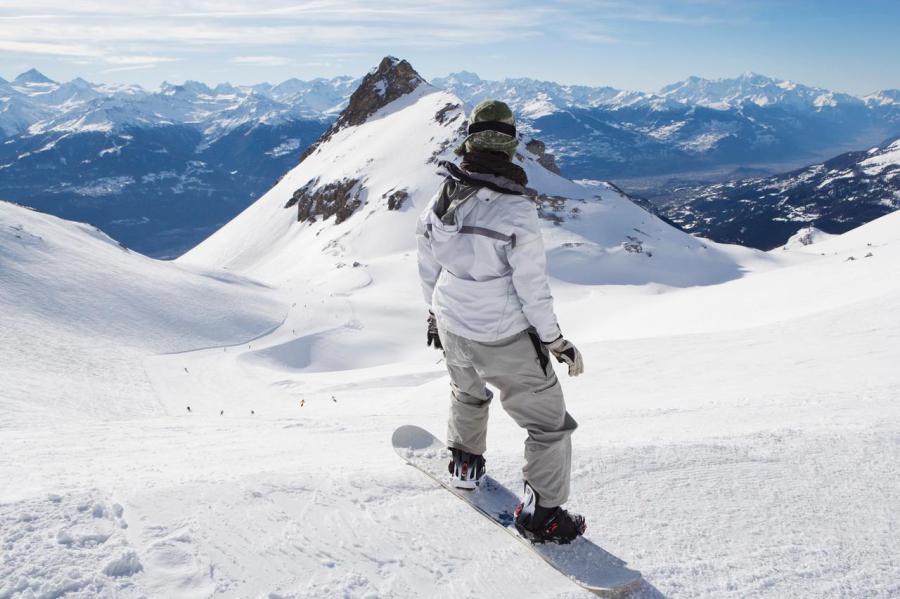
There's more to early season skiing than squeezing in a cheeky weekend in the run up to Christmas! Skiing is possible on some Alpine glaciers as early as September, with more options generally becoming available through October and November as the first non-glacier ski areas begin to open.
By late November and early December, many of the major high-altitude ski resorts (and a few low ones) are gearing up for the winter season, with at least some pistes operational, although the extent and quality of skiing can vary considerably depending on altitude, snowfall and snowmaking.
Indeed, some resorts are now so good at snowmaking that large parts of their ski areas can be open before a single flake of snow has even fallen. Nowhere is this better illustrated than in the Dolomites, where skiers in the Dolomiti Superski area (e.g. Selva, Corvara, Arabba) have been able to enjoy hundreds of kilometres of perfectly maintained pistes, made entirely of artificial snow.
For those that just can't wait to hit the slopes, here is our guide to early season skiing in the Alps...
September
Skiing in the Alps in September is generally limited to a handful of high-altitude glaciers, where the amount of terrain available can be quite restricted. With temperatures starting to drop after the summer, you might get lucky and experience some fresh snow, but conditions are highly variable and skiing can be very limited.
Until recently, we used to recommend Hintertux (Austria) as one of the best options for serious early-season skiers, thanks to its relatively steep and varied glacier terrain. However, following a succession of hot summers, it now takes a break from skiing operations during the summer months – its former claim to be open “365 days a year” sadly a thing of the past – and skiing may not resume here until late September or even early October.
Zermatt and Saas-Fee (Switzerland) have traditionally been two of the best options for September skiing in the Alps, thanks to their exceptionally high glacier ski areas. Both are charming Alpine villages and appealing bases for an early autumn break, although the skiing available in September is much more limited than the varied terrain available during the winter months.
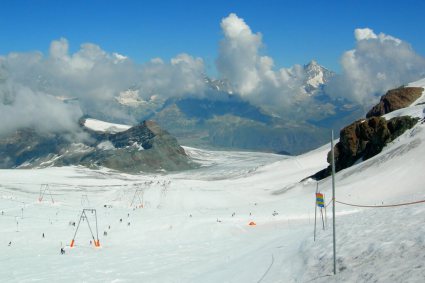 "Summer" skiing on the Theodul Glacier above Zermatt.
Zermatt offers mostly gentle glacier skiing at almost 3900m, while Saas-Fee can have some slightly steeper terrain open. In a good year, both can offer up to 20km of pistes in September, although considerably less has been more common in recent years. These days, even at these altitudes, prolonged summer heat can prevent skiing well into September, so neither resort can guarantee that its glacier will be open. Anyone planning a trip specifically to ski should check the latest operating conditions before travelling.
A handful of much smaller glacier ski areas can also open in September, although the terrain is extremely limited and generally better suited to local enthusiasts or race training than anyone planning a ‘real’ ski holiday.
September skiing is therefore best suited to enthusiasts looking for an early-season workout rather than anyone expecting a conventional ski holiday, with extensive pistes and a fully functioning resort.
October
October sees more and more glacier ski areas opening across the Alps – and, in good years, even the first non-glacial terrain too – with the possibility of some excellent snow conditions following the first significant autumn snowfalls.
However, the amount of skiing available can still vary enormously from one year to the next, and prolonged warm weather can delay openings or leave glaciers with very limited terrain.
For keen skiers, Hintertux (Austria) remains one of the best options, thanks to its relatively steep and varied glacier terrain, but Sölden (Austria) is another excellent choice, with two extensive glaciers, plenty of variety, and the possibility of some non-glacial pistes opening later in the month, snow conditions permitting.
Austria generally offers the widest choice of October skiing in the Alps, with other possibilities including the Stubai, Pitztal and Kaunertal glaciers, as well as the Kitzsteinhorn above Kaprun. However, the amount of terrain available at these ski areas can be quite limited, and (aside from Kaprun) they generally lack the atmosphere of a more established ski resort.
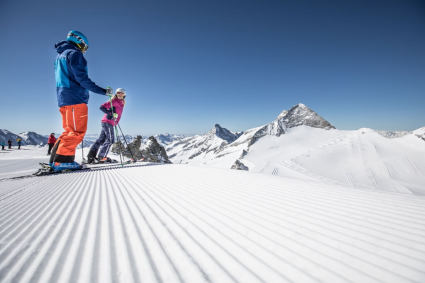 Early-season skiing on the Hintertux Glacier, Austria – Photo: Hintertux Gletscher
In Switzerland, Zermatt and Saas-Fee are traditionally the main options. In Italy, the glaciers at Val Senales and Passo Stelvio can also offer good autumn skiing, although they also lack the classic ‘ski resort’ atmosphere and tend to attract local enthusiasts and race training groups. Cervinia typically begins its winter season towards the end of October, with a more established ski town vibe, initially offering access to the high glacier slopes it shares with Zermatt.
France currently has no reliably scheduled October glacier skiing. Tignes traditionally offered autumn glacier skiing, but October operations have become much less dependable in recent years.
For anyone planning an October ski trip, flexibility is key. Even where glaciers are open, the extent of skiing may be limited, and conditions can change quickly. October is still primarily a month for keen enthusiasts prepared to take advantage of good conditions at the last minute, rather than those looking for a conventional ski holiday.
November
November is when early-season skiing in the Alps really starts to get interesting, particularly during the second half of the month. The glaciers remain the safest bets early on, but as the month progresses, some of the big-name ski resorts begin opening their lifts, often with considerably more terrain available than you might expect.
For anyone itching to get on skis in early November, Sölden (Austria) is one of our favourites. Its extensive glacier skiing, combined with the possibility of non-glacial pistes opening as conditions allow, makes it a more appealing proposition for a short break or early ski holiday than many of the smaller glacier-only ski areas.
In Switzerland, Zermatt and Saas-Fee also remain great options in November, with both usually also opening non-glacial terrain towards the end of the month. Cervinia (Italy) is another resort worth considering, particularly if its skiing extends below the glacier onto the Italian side, which it can do at this time of year, depending on snow conditions.
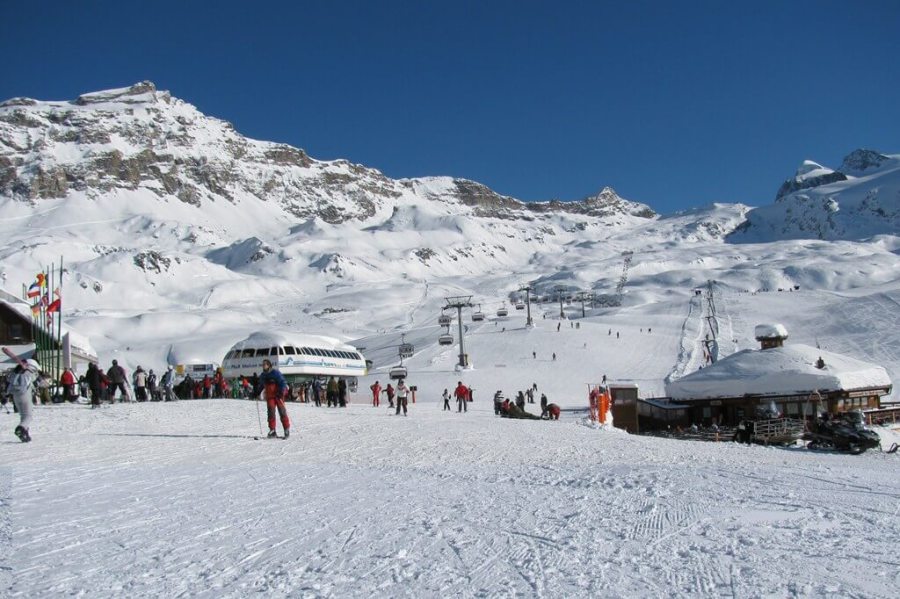 In a good early season, skiing can extend down to Plan Maison (2550m) in Cervinia by November.
For a more conventional ski holiday, however, we'd generally recommend waiting until the second half of November, which also sees a clutch of other big-name resorts fire up their lifts for the first time. In Austria, Obergurgl is traditionally one of the first major non-glacial resorts to open, while Ischgl can be particularly impressive towards the end of the month, thanks to its extensive high-altitude terrain and excellent snowmaking.
In France, Val Thorens and Tignes are among the most appealing options for a late-November break, although other parts of the 3 Valleys are unlikely to be open, and the full Tignes–Val d'Isère ski area is not normally scheduled to open until the end of the month. Snow conditions here may already be excellent at altitude but, even if natural snowfall has been in short supply, both resorts have the snowmaking capacity to provide some decent piste skiing.
Late November can offer some fantastic skiing, often with quiet pistes and attractive early-season prices. The trick is choosing somewhere high enough, or with excellent early-season snowmaking, and a decent amount of terrain already scheduled to open, while remembering that even the most snow-sure ski resorts are still at the mercy of the weather.
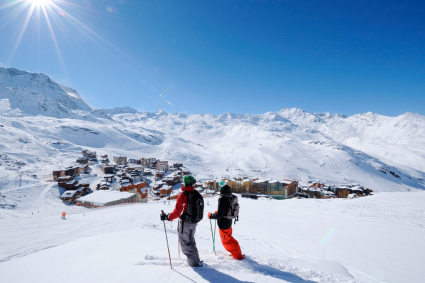 Val Thorens is one of the best options for an early-season ski holiday in the French Alps.
December
By December, the Alpine ski season is getting into full swing. Most major ski resorts aim to be open by the middle of the month, although some smaller ski areas don't get going until closer to Christmas. The choice of destinations is now much wider, but early-season snow conditions can still vary enormously, so choosing the right resort remains key.
Lots of resorts have the potential to offer great skiing in December, but for an early December ski holiday, we'd generally favour resorts with plenty of high-altitude terrain, a good early-season snow record and/or extensive snowmaking facilities.
Our early December favourites include Val d’Isère, Tignes and Val Thorens (France), Cervinia (Italy), Zermatt (Switzerland) and Obergurgl, Sölden and Ischgl (Austria), all of which have the potential to offer excellent skiing well before Christmas. These resorts combine relatively snow-sure skiing with the facilities and atmosphere you'd expect from a proper winter holiday.
However, altitude isn't everything. The Dolomites are a particularly good example of how sophisticated snowmaking can compensate for a lack of natural snowfall. Resorts like Selva, Corvara and Arabba can offer beautifully prepared pistes in early December, even when the surrounding mountains are looking rather bare.
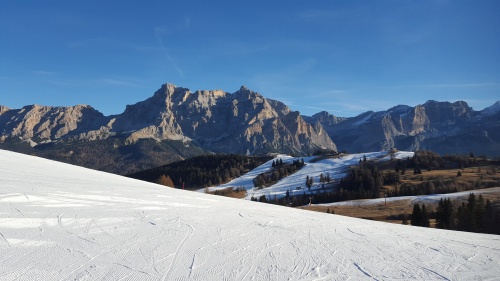 Snowmaking allows the Dolomites to offer excellent early-season skiing, even when the surrounding mountains have little natural snow.
One of the biggest attractions of skiing in early December is the chance to enjoy the slopes before the Christmas crowds arrive. Prices can also be considerably more attractive than during the peak holiday weeks, making it a great time for a short break or even a full week's skiing.
That said, we'd still advise being selective, especially for a trip during the first week of December. A resort may officially be open without offering anything like its full ski area, and links between different sectors can take longer to become operational. If extensive skiing is your priority, it's worth checking how much terrain is actually expected to be open, rather than relying on the advertised opening date alone.
As we move towards the middle of December, the choice of resorts expands considerably, with many more lower and mid-altitude ski areas beginning their winter seasons. In Austria, the Arlberg Region, including St Anton, Lech-Zürs and Warth-Schröcken, can often be close to fully operational and a great option. This is one of the snowiest parts of the Alps and can offer superb early-season conditions when the northern Alps have seen plenty of snowfall. Obertauern is another favourite thanks to its high, snow-sure setting.
In France, the resorts of the Paradiski (La Plagne and Les Arcs) and 3 Valleys ski areas (such as Val Thorens, Courchevel and Méribel) can become good options due to the extent of high-altitude terrain they can offer.
In Switzerland, Saas-Fee is still a good option but is unlikely to be able to compete with the extent of terrain now open in Zermatt and other Swiss resorts, such as Verbier and St Moritz.
By Christmas and New Year, the vast majority of Alpine ski resorts are normally open, giving those looking to hit the slopes a much wider choice of options. While the high-altitude resorts remain the safest bets when natural snowfall has been limited, there is no reason to rule out lower resorts altogether. In a snowy December, some of the best conditions can be found at more modest altitudes, particularly in areas that have benefited from early winter storms or that have particularly good snowmaking.
Of course, Christmas and New Year are among the busiest and most expensive weeks of the ski season, so the choice of resort becomes about more than snow reliability alone. Families may want to consider the extent of beginner and intermediate terrain open, and the likelihood of being able to ski back to the village, or their accommodation – which can be just as important as the amount of snow there is higher up the mountain.
With so many resorts now open, Christmas and New Year can offer some fantastic skiing across the Alps. As ever, conditions can vary considerably from one region to another, and the best choice of resort will depend on how the early winter has unfolded.
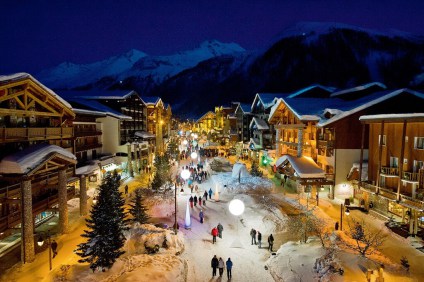 Val d'Isère looking particularly festive on a snowy winter evening – Photo: Andy Parant
Planning an early-season ski holiday?
At Snow-wise, our extensive knowledge of Alpine resorts, ski areas, hotels and, crucially, weather and snow conditions puts us in an excellent position to help you choose the right destination for an early-season ski holiday.
Whether you're looking for a cheeky pre-Christmas break or a family ski holiday over Christmas and New Year, get in touch and let us help you create the perfect tailor-made ski holiday.
Call us on: +44 (0)20 3397 8450
Email us at: info@snow-wise.com
To be the first to hear about our latest offers:


 Print