

El Niño 2026–27: should it influence where you book your ski holiday in the Alps?
By Fraser Wilkin ,
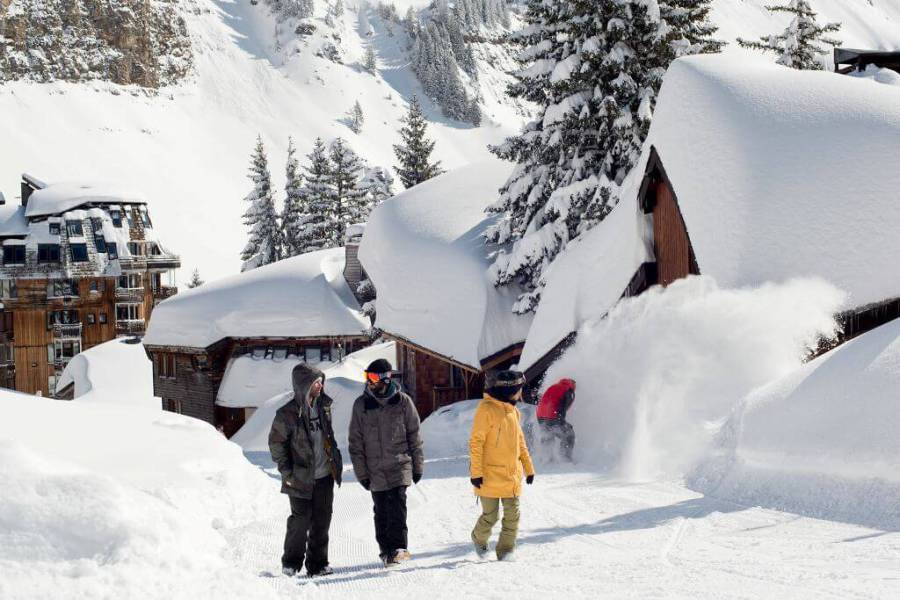 Deep mid-season snow cover in Avoriaz during the strong El Niño winter of 2015–16. – Photo: avoriaz.com
With a powerful El Niño developing ahead of the 2026-27 ski season, predictions of a snowy winter are attracting plenty of attention. But should they influence where you choose to ski?
Every autumn brings speculation about what the winter ahead will bring for the Alps, but this year much of it centres on El Niño, the warming of tropical Pacific waters that can influence weather patterns around the world.
Historically, El Niño has had more of a direct effect on snow conditions in North America than in Europe, but with this year’s El Niño event potentially being the strongest on record, there is a chance that it could also have more of an influence on snow conditions in the Alps.
However, there's a big difference between an interesting long-range weather signal and something you can confidently base a ski holiday booking on.
A snowy winter doesn't necessarily mean good skiing everywhere. And, even in winters remembered for exceptional snowfall, conditions can vary enormously from region to region, and even resort to resort.
Altitude matters, of course, but so does geographical location, slope orientation, exposure to prevailing weather systems and the extent of skiing available at higher elevations. A storm that delivers a lot of snowfall to one part of the Alps might bring rain to another, or even miss it altogether.
What does El Niño change?
As a self-confessed snow and weather geek (and founder and editor of Weather to Ski), I’ve been closely following the developing 2026 El Niño and what it could mean for the 2026-27 ski season.
Traditionally, El Niño’s influence on European winters is weak and easily overridden by other atmospheric patterns. In the Alps, some previous El Niño winters turned colder later in the season, sometimes favouring snowfall further south. The last exceptionally strong El Niño in 2015-16 got off to a very mild start with severe snow shortages, before conditions improved from January, with March turning out to be one of the best months of the season.
This year, though, a stronger El Niño could bring a more active Atlantic pattern early in the winter. That could mean big early snowfalls at altitude in the western and northern Alps, although milder storms could bring rain lower down.
But there are significant uncertainties: where these storms will track, what other systems might interfere, and whether they bring cold or mild air. All of this involves complex interacting weather systems, so it is far too early to be sure which resorts will be the snowiest.
So, will El Niño deliver a bumper winter in the Alps in 2026–27?
Possibly, although we wouldn't recommend choosing your ski holiday on that basis alone. For now, a resort’s established snow reliability at the time of year you intend to travel is a much better starting point.
What makes an Alpine ski resort snow-reliable at different times of winter?
For an early-December holiday, we’d look closely at altitude, the amount of high-level terrain available and the resort's usual opening dates. Snowmaking capacity is also important, as is how proactive a resort is about opening as much terrain as possible early in the season.
The big-name high-altitude resorts may not always be the best options. Lower-altitude doesn’t have to mean unreliable. In parts of the Dolomites, for example, extensive snowmaking and excellent piste preparation can produce superb on-piste skiing at lower altitudes even when natural snowfall has been limited.
For more on early-season skiing options, read our complete guide to early-season skiing in the Alps.
By January and February, the choice is wider, as many lower-altitude resorts can offer excellent skiing once a good base has developed. And for Easter skiing, the proportion of slopes at altitude and their orientation become particularly relevant again.
None of this guarantees perfect conditions, but it provides a more reliable starting point than trying to predict precisely where the snow will fall months in advance.
Should you book your ski holiday now or wait to see how the winter develops?
It’s sometimes (understandably) tempting to delay booking until we have a clearer picture of the winter's snow conditions, although there is a trade-off.
For popular dates, particularly Christmas, New Year and February half-term, waiting for reliable snow forecasts could mean finding that your preferred flights, resort or accommodation are fully booked, or considerably more expensive.
If you are travelling outside the peak weeks and can be flexible about both destination and accommodation, waiting until closer to departure may be a more realistic option. You can then make a decision based on actual snow conditions rather than seasonal speculation.
For most people booking well in advance, however, we'd recommend choosing a resort that suits their requirements and the time of year, rather than trying to second-guess the weather months ahead.
How Snow-wise can help...
At Snow-wise, we combine our first-hand knowledge of Alpine resorts and hotels with my decades of studying snow and weather patterns to help you choose the right destination for your ski holiday, whether you're planning an early-season trip, a February half-term holiday or a late-season escape.
We also keep a close eye on weather and snow conditions throughout the winter. If you're booking at short notice, we can advise where the snow looks best at the time. And if you've already booked but the weather isn't behaving as expected, we can help you make the most of the conditions where you're going.
Call us on: +44 (0)20 3397 8450
Email us at: info@snow-wise.com
For a more detailed meteorological analysis, read my article on Weather to Ski:
Could the 2026 El Niño mean more snow for the Alps this winter?
To be the first to hear about our latest articles and offers:


 Print